- Available 24/7 by Appointment


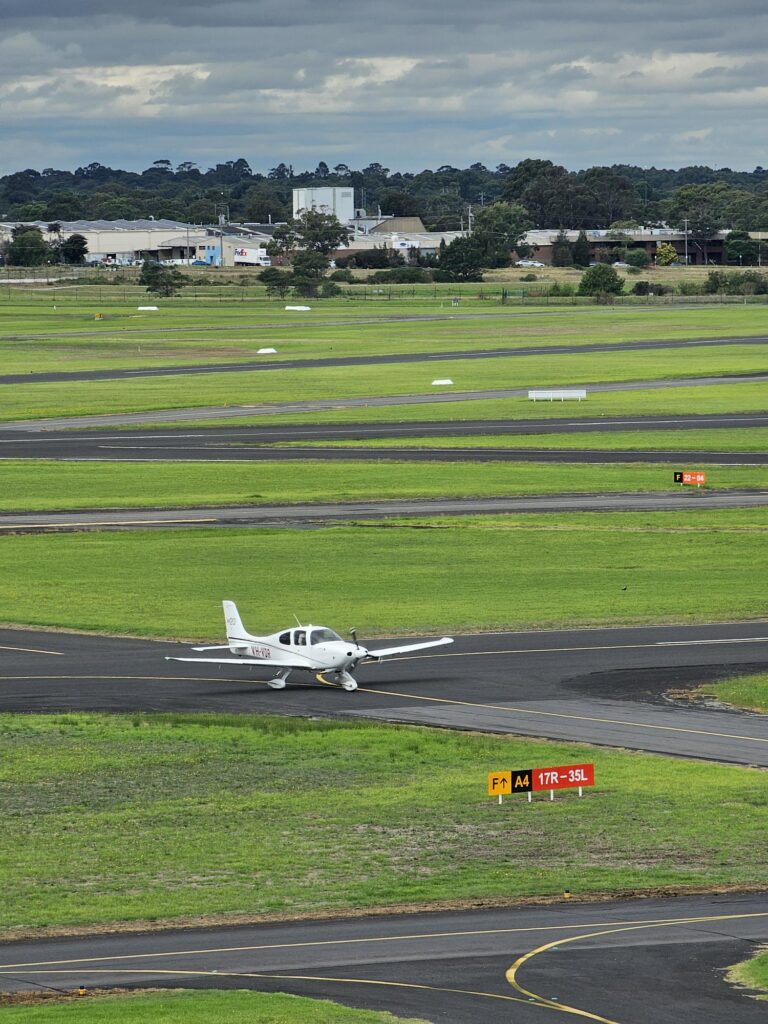
If you’re considering flight training at Moorabbin, you’re looking at one of Melbourne’s most established general aviation and pilot-training environments.
Moorabbin Airport (YMMB), located in Melbourne’s south-east, is home to multiple flight-training providers and supports training ranging from introductory flights and recreational licences through to commercial, instrument, multi-engine and instructor training.
For a student pilot, however, choosing Moorabbin is only the first decision.
The flight school you select, the aircraft you train in, instructor availability, how frequently you fly and the licence you’re working towards can all influence how long your training takes, what you learn and how much you ultimately spend.
This guide explains what flight training at Moorabbin is actually like, the licences and ratings you can work towards, what training may cost and what you should look for when choosing a flight school.
Yes, you can learn to fly from zero experience at Moorabbin Airport.
Depending on the flight-training provider and program you choose, training available at Moorabbin can include:
Moorabbin Airport is located in Melbourne’s south-east and operates as a controlled general aviation airport.
For students, that means the airport environment itself becomes part of the training.
You aren’t simply learning how to control an aircraft. You are also gradually learning how to operate around other aircraft, communicate with air traffic control, follow taxi and circuit procedures and manage the workload associated with flying at an active airport.
That can make Moorabbin particularly interesting as a training location.
Moorabbin has been an important part of Melbourne’s general aviation community for decades.
Today, it remains home to a significant amount of flight-training activity.
Some of the characteristics that make Moorabbin attractive to students include:
For a new student, one of the biggest differences compared with training at a quieter uncontrolled aerodrome is the amount of operational activity happening around you.
That can initially feel busy.
Over time, however, the procedures that seemed complicated during your first few lessons can become a normal part of operating an aircraft.
Moorabbin operates as a controlled airport.
That means air traffic control plays a role in managing aircraft operating on and around the aerodrome.
As a student, you will progressively become familiar with areas such as:
You are not expected to understand all of this during your first flying lesson.
Your instructor introduces these procedures progressively.
Initially, you may find yourself concentrating heavily on simply flying the aircraft while your instructor handles more of the communication and planning.
As your capacity increases, more responsibility is gradually transferred to you.
Eventually, radio communication and controlled-airport procedures become part of the normal workload of operating the aircraft.
Moorabbin can have a wide range of aircraft operating at the same time.
You may encounter:
Learning in that environment can help build awareness of what’s happening around your aircraft.
You learn that flying isn’t performed in isolation.
You need to listen to the radio, maintain a lookout, understand where other traffic may be and anticipate what ATC or another aircraft may do next.
That situational awareness develops progressively throughout your training.
Training at a busy airport has both advantages and disadvantages.
Potential benefits include:
But there can also be practical considerations.
During busy periods, you may experience:
If the aircraft is being charged by time, time spent on the ground can still contribute to the cost of a lesson.
This is why it would be misleading to say that training at a busy airport automatically makes someone a better pilot.
The operating environment can provide valuable experience, but students should also understand the potential time and cost implications.
One of Moorabbin’s advantages is the range of training available across different providers.
A broad pilot-training pathway may look like:
First Flight → RPL → PPL → CPL → Advanced Ratings → Professional Flying
But this isn’t a compulsory sequence for everyone.
If you want to fly recreationally, you might stop at an RPL or PPL.
If you want greater private flying capability, you may add further endorsements or ratings.
If you want to fly professionally, you may continue through a CPL and then into instrument, multi-engine, instructor or other advanced training.
The right pathway should therefore be based on what you actually want to do with an aircraft.
If you have never flown a light aircraft before, an introductory flight can be a useful place to start.
Different schools may use terms such as:
The exact format varies between providers, but the basic idea is similar.
You fly with an instructor and experience what a real light-aircraft flight feels like before committing to a complete pilot-training program.
During the experience you may:
For many people, yes.
Flight training represents a significant commitment of both time and money.
An introductory flight gives you the opportunity to experience the school, instructor, aircraft and airport before making that commitment.
You may find that you immediately love flying.
You may also discover that you prefer another aircraft, instructor or training environment.
Either result is valuable information.
Think of the flight as more than an experience product.
Use it to evaluate the school.
The Recreational Pilot Licence is often the first formal licence milestone for Australian flight students.
An RPL is designed around recreational flying and provides more limited privileges than a PPL.
Training develops core skills such as:
The basic RPL has limitations compared with a PPL, including restrictions relating to how far you can operate from your departure aerodrome unless additional endorsements are held.
Additional training can expand those privileges.
An RPL may suit someone who:
It can also form part of a longer professional pathway.
The important point is that you don’t necessarily need to decide during lesson one whether your eventual goal will be recreational or professional flying.
But if you already know where you want to end up, tell your flight school.
Your long-term goal can influence how your training is planned.
A Private Pilot Licence provides broader private flying privileges than the basic RPL.
For many recreational pilots, the PPL is where an aircraft starts becoming a tool for travel rather than simply something flown around a local training area.
PPL training places greater emphasis on navigation and independent flight planning.
You may develop skills involving:
A PPL may suit someone who wants to:
A PPL remains a private licence.
If your goal is to be paid to fly, the professional pathway continues towards a CPL.
For career-focused students, the Commercial Pilot Licence becomes one of the major milestones.
A CPL allows you to exercise commercial pilot privileges, subject to the requirements of the operation and any additional ratings or qualifications required.
Commercial training involves substantially more than simply building flight hours.
Students need to develop greater depth in areas such as:
Commercial students also undertake a substantial theoretical component.
The broader professional pathway may eventually include:
CPL → Instrument Rating → Multi-Engine Training → Instructor or Other Qualifications → First Flying Job → Experience Building
Some Moorabbin providers offer structured full-time commercial programs.
A full-time pathway may include:
The main benefit is training continuity.
If you’re flying and studying several times per week, each lesson can build directly on the previous one.
The trade-off is the commitment required.
Full-time pilot training can demand substantial time and a concentrated financial commitment.
A modular pathway can offer greater flexibility.
This may suit someone who wants to:
The main challenge is consistency.
Part-time does not necessarily mean cheaper.
If large gaps develop between lessons, some future training time may be spent revising skills you had previously learned.
There is no universal answer.
Consider:
Time + Finances + Career Goals + Ability to Train Consistently
A full-time program that you cannot financially sustain isn’t automatically the better choice.
Likewise, a flexible program where you fly once every several months may not be particularly efficient.
The right pathway is the one that lets you train consistently enough to keep progressing.
Flight training does not necessarily end with an RPL, PPL or CPL.
Depending on your goals, you may progress into more advanced aircraft and operations.
Instrument training develops the skills required to operate under the Instrument Flight Rules within the privileges of the rating held.
Training can involve areas such as:
Instrument capability is particularly relevant for many professional pilots, although private pilots may also pursue instrument qualifications.
Multi-engine training introduces aircraft with more than one engine.
This involves learning new systems, aircraft-performance considerations and procedures associated with engine failures.
For professional pilots, multi-engine experience can form part of a broader career pathway.
A Multi-Engine Command Instrument Rating combines instrument-flying capability with operations in multi-engine aircraft.
It is relevant to many professional pathways.
However, obtaining one should not be presented as guaranteeing an airline or charter job.
It’s a qualification.
Employment still depends on the requirements of individual operators, pilot experience, recruitment conditions and other factors.
There is no single price for flight training at Moorabbin.
Your total cost depends on factors such as:
Aircraft choice alone can move the total training cost considerably.
For example, 50 flight hours at $350 per hour represents $17,500 in aircraft time.
At $600 per hour, 50 hours represents $30,000.
At $900 per hour, the same 50 hours represents $45,000.
That is before other training expenses are considered.
This doesn’t mean everyone should choose the cheapest aircraft.
It means the aircraft you train in is an important part of understanding the overall cost.
The research originally used for this article identified broad planning ranges of approximately:
| Training Pathway | Indicative Planning Range |
| CPL pathway | $65,000–$115,000+ |
| CPL + Instrument Rating | $80,000–$120,000+ |
These should not be treated as fixed Moorabbin prices.
Training costs can vary significantly between providers, programs, aircraft and individual students.
For a current comparison, request an itemised estimate directly from the school.
An advertised aircraft hourly rate isn’t necessarily the total price of a lesson.
Depending on the school, your actual training cost may involve:
Aircraft + Instructor + Briefing + Airport Charges + Other Fees
Some schools quote a combined dual-training rate.
Others separate the aircraft and instructor costs.
Briefing may be included or charged separately.
Airport charges can also vary.
This is why comparing two schools based purely on the number displayed beside an aircraft can be misleading.
Yes.
Different aircraft have different:
A modern technically advanced aircraft may cost substantially more per hour than a simpler trainer.
For one student, that additional capability may align perfectly with the aircraft they eventually want to fly.
Another student’s priority may be reaching a licence standard in the most economical training aircraft suitable for the job.
Neither approach is automatically right or wrong.
When budgeting for flight training, consider the expenses that may sit outside the advertised aircraft or course price.
These can include:
Theory examinations may be required depending on the licence or rating.
The medical requirements depend on the licence and privileges you intend to exercise.
If professional flying is your goal, investigate your medical position early.
An Aviation Security Identification Card may become relevant depending on airport access and the type of operations you’re undertaking.
Many students eventually purchase their own aviation headset and other basic equipment.
Theory may be included in a program or charged separately.
Ask whether these are incorporated into your flight-training rate.
Many pilots use tablet-based aviation navigation and flight-planning software.
Flight-test aircraft hire, examiner costs and associated charges may sit outside normal training rates.
This can become one of the largest variables.
Minimum regulatory hours should not automatically be treated as the exact number of hours every student will need.
You still have to reach the required competency standard.
Before comparing schools, ask:
What is actually included in this price?
Some eligible aviation diploma programs may provide access to VET Student Loans for eligible students.
That does not mean every flight-training course qualifies.
It also does not necessarily mean the entire cost of becoming a commercial pilot will be covered.
There may be:
Before enrolling, ask:
VSL should be viewed as a funding mechanism, not as free flight training.
There is no universal timeframe.
The answer depends on:
Someone working towards an RPL or PPL while working full-time may train over many months or longer.
A student flying regularly may progress considerably faster than someone flying once every few weeks.
The original research used for this article identified approximately 18–24 months as a broad planning timeframe for some full-time CPL plus instrument-rating pathways.
That should be treated as indicative, not guaranteed.
A longer modular professional pathway may extend over two to four years or more, depending heavily on training frequency.
The important question isn’t simply:
How long does the course take?
Ask:
How frequently will I realistically be able to fly?
Training frequency can influence both completion time and total cost.
Flying monthly can result in substantial gaps.
Especially early in training, skills may fade between lessons and more time may be spent revising.
Weekly flying can provide a practical balance for many recreational students.
It provides a regular training rhythm while still allowing time for work and other commitments.
Students seeking faster progression may benefit from several training sessions each week.
This can be particularly useful for career-focused or full-time students.
Frequent training allows new skills to be reinforced while they’re still fresh.
The important relationship is:
Training Frequency → Skill Retention → Progression → Cost
The question isn’t simply how many flight hours you require.
It’s how efficiently you can build those hours while retaining what you’ve learned.
Weather is an unavoidable part of flight training.
Conditions that can affect a lesson include:
Training flights will occasionally be cancelled because the conditions aren’t suitable for the planned exercise or the student’s level of experience.
This makes booking frequency important.
Imagine you book one flight every two weeks.
If your next lesson is cancelled due to weather, you may suddenly have a four-week gap between flights.
If you maintain several bookings, weather cancellations can be easier to absorb without substantially disrupting your training.
This is another reason availability matters when comparing Moorabbin flight schools.
Moorabbin has multiple flight-training providers.
That gives students choice—but it also means you need a sensible way to compare them.
The first question should not be:
Which school is cheapest?
Start with:
Which school best suits the type of pilot I want to become?
Decide whether you want to fly:
Your goal changes what you should look for.
Someone wanting to fly a few weekends each month does not necessarily need the same training environment as someone planning to complete a CPL, instrument rating and professional pathway.
Ask what aircraft you will actually train in.
Consider:
Don’t focus only on how many aircraft the school owns.
Find out how many aircraft are realistically available to students at the times you want to train.
A large fleet doesn’t automatically mean excellent availability.
A school could have many aircraft and even more students competing for them.
Ask:
“If I wanted to fly twice per week, could you realistically accommodate me?”
That can tell you far more than a fleet-size number on a website.
Good flight instruction is about more than the number of hours an instructor has flown.
Look for instructors who can:
Ask whether you are likely to have a primary instructor.
Flying with different instructors occasionally can be valuable because each person may notice different things or explain concepts differently.
Constant instructor changes, however, can affect continuity if training records and handovers are poor.
Find out how the school manages instructor allocation.
Ask:
Availability directly affects your ability to maintain a consistent training schedule.
Flight schools can offer different training models.
These may include:
The right structure depends on your goals and circumstances.
Don’t simply ask:
“What’s your hourly rate?”
Ask:
“What does a typical student actually spend from their first lesson until completing the licence in the aircraft I intend to train in?”
Then request an itemised estimate.
That gives you a much more useful comparison.
Yes.
Moorabbin students may have access to a wide variety of aircraft depending on the flight school.
These can range from relatively simple traditional trainers through to modern glass-cockpit and higher-performance aircraft.
Your choice affects:
The cheapest aircraft isn’t automatically the right aircraft.
The most expensive aircraft isn’t automatically the best either.
Think about:
Cost + Technology + Capability + What You Intend to Fly After Training
If you already know that you intend to fly a particular type of aircraft after licensing, it may make sense to consider that when choosing your training platform.
Not necessarily harder—but potentially busier.
A student learning at Moorabbin may need to progressively become comfortable with:
That can seem intimidating before your first lesson.
But beginners aren’t expected to manage every part of the operation immediately.
Your instructor progressively increases your responsibilities as your flying skills and capacity improve.
Something that seems overwhelming during lesson one can feel completely routine months later.
The busy environment should therefore be viewed as something to learn, rather than automatically something to avoid.
Moorabbin can provide a relevant environment for students pursuing professional aviation.
Students may gain experience with:
However, where you completed your initial training is only one part of becoming a professional pilot.
Training at Moorabbin does not itself guarantee an employment advantage.
Employers may consider factors including:
Moorabbin can provide useful operational exposure.
It should not be sold as a shortcut to employment.
Absolutely.
Moorabbin isn’t only a location for students pursuing airline or commercial careers.
Recreational students may train towards:
Part-time and weekend training may also be available depending on the provider.
For recreational students, priorities may include:
You don’t need to enrol in a professional aviation pathway simply because professional programs are available at the airport.
For most complete beginners, an introductory flight is a useful way to evaluate a school before committing to a large training program.
Use the experience to assess:
Ask questions while you’re there.
For example:
How often can students book?
Would you have a regular instructor?
What aircraft would you learn in?
What licence would the school recommend based on your goal?
What would a typical student spend?
What would happen after that first licence?
You’re not simply deciding whether you enjoy flying.
You’re deciding whether you can see yourself completing months or potentially years of training with that organisation.
Before choosing a provider, ask:
Don’t expect every school to give identical answers.
The point is to understand the differences before you commit.
There is no single price.
Your total cost depends on the licence you’re working towards, the aircraft you choose, hourly rates, instructor and briefing fees, airport charges and how many flight hours you ultimately require.
For a useful comparison, ask each school what a typical student spends from their first lesson until completing the intended licence in the aircraft you plan to use.
Moorabbin is an established general aviation and flight-training airport with air traffic control, multiple runways and significant training activity.
This can provide regular exposure to radio communication, controlled-airport procedures and other traffic.
The trade-off is that busy periods may also create additional taxi time, traffic sequencing or delays.
It depends on the licence and how regularly you train.
A recreational student flying weekly has a very different schedule from a full-time commercial student.
Weather, aircraft availability, instructor availability, theory and individual progress all influence the completion time.
Yes.
Depending on the flight school, recreational and modular training may be completed around work or other commitments.
The main consideration is maintaining sufficient frequency.
Part-time training works best when it remains consistent.
Training available across Moorabbin providers can include RPL, PPL and CPL programs, with further instrument, multi-engine and instructor training also available depending on the organisation.
Your pathway should be based on your intended type of flying rather than assuming you need every available qualification.
Yes.
You aren’t expected to understand controlled-airport procedures, radio calls and busy traffic before your first flying lesson.
These skills are introduced progressively by your instructor as your ability and confidence develop.
Moorabbin has many of the characteristics you would expect from an established flight-training location.
These include:
But deciding to train at Moorabbin is only the first decision.
The flight school, aircraft, instructor and training schedule you choose will have a much greater influence on your individual experience.
Before enrolling, visit prospective schools.
Look at the aircraft.
Meet the instructors.
Ask how often you can realistically fly.
Understand what happens if your aircraft or instructor becomes unavailable.
And request a realistic, itemised training estimate rather than relying on a headline hourly rate.
A busy airport doesn’t automatically produce a better pilot.
A bigger school isn’t automatically a better school.
A cheaper aircraft doesn’t automatically result in a cheaper licence.
The best flight training at Moorabbin is the training environment that gives you consistent access to suitable aircraft, good instruction and a pathway that matches what you actually want to achieve as a pilot.
Yes. Moorabbin Airport is one of Melbourne’s major general aviation and flight-training locations, with multiple training providers operating from the airport. It is a controlled airport, meaning students gain experience communicating with air traffic control, following clearances and operating around other training and general aviation aircraft.
The busy environment can initially add to a new student’s workload, but radio communication, traffic awareness and controlled-airport procedures are introduced progressively throughout training.
Depending on the flight school you choose, training at Moorabbin can include Recreational Pilot Licence (RPL), Private Pilot Licence (PPL), Commercial Pilot Licence (CPL), instrument training, multi-engine training and Flight Instructor Rating training.
You don’t necessarily need to complete the entire pathway. Recreational pilots may stop at an RPL or PPL, while someone pursuing aviation professionally may continue through CPL and additional ratings.
There is no single price for flight training at Moorabbin. Your total cost depends on the licence you’re completing, aircraft you train in, aircraft and instructor rates, number of flight hours required, airport charges, training frequency and any additional ratings.
When comparing Moorabbin flight schools, don’t rely solely on the advertised hourly aircraft rate. Ask what’s included and what a typical student actually spends from their first lesson through to completing the licence.
Yes. You don’t need any previous flying experience before starting flight training at Moorabbin.
While Moorabbin’s air traffic, radio calls and controlled-airport procedures can make it appear complicated from the outside, beginners aren’t expected to understand everything immediately. These skills are developed progressively alongside learning to control the aircraft.
An introductory flight can also be a useful first step, allowing you to meet an instructor, experience the aircraft and see what flying from Moorabbin is actually like before committing to a full training program.
Start with what you want to achieve. Someone wanting to fly recreationally may have very different requirements from someone pursuing a commercial aviation career.
Then compare schools based on aircraft, instructor quality, instructor continuity, booking availability, training structure and realistic total cost.
One particularly useful question to ask is:
“If I wanted to fly twice a week, could you realistically accommodate me?”
A school may have an impressive fleet, but what ultimately matters is whether suitable aircraft and instructors are actually available when you need them.